Mysterious 1,000-Mile Cloud on Mars May Reveal Hitherto Unseen Atmospheric Physics
· GlobeWire Daily Science Desk · Source: arstechnica.com
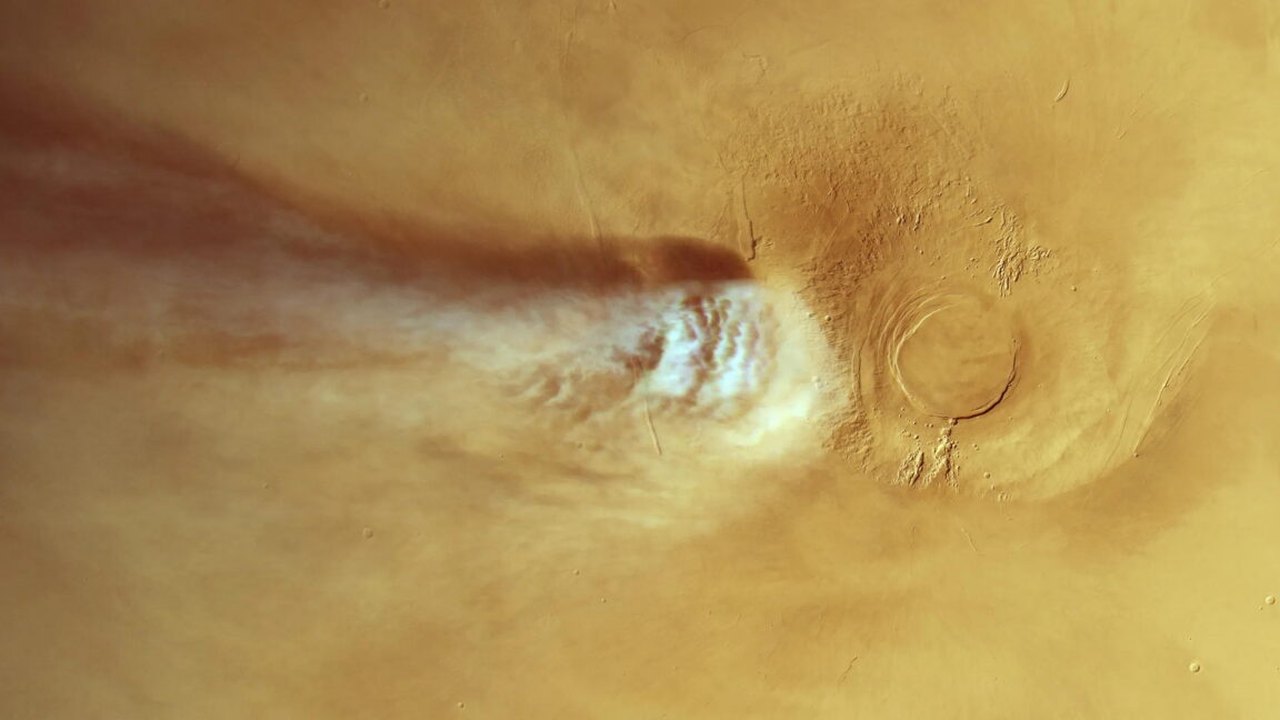
Image: arstechnica.com — Creative Commons
A Recurring Martian Mystery
Every morning during the Martian spring and summer, a thin, extraordinarily long cloud forms near the towering volcano Arsia Mons. Over the course of the morning, the formation stretches over 1,000 miles—roughly the distance from New York City to Kansas City—before completely dissipating. The cycle then repeats day after day for several months.
First recorded by a space probe in 2018, this recurring atmospheric phenomenon is known as the Arsia Mons Elongated Cloud (AMEC). Until recently, planetary scientists lacked a plausible explanation for how such a massive structure could form and vanish with such regularity.
Simulating Exotic Physics
Researchers have now successfully modeled the cloud's formation for the first time. Published in Nature Geoscience, the new study indicates that the AMEC may be driven by a physical process that has never been directly observed in the atmosphere of any planet.
"We found that we needed to include some exotic physics… physics that, while included in textbooks, is treated as theoretical and usually thought not to happen in nature. It certainly hasn’t been seen in action before," said Jorge Hernández-Bernal, a planetary scientist at Sorbonne Université in Paris and lead author of the study. "Once we included this physics in our simulations, the AMEC emerged just as we hoped."
Homogeneous Nucleation Under Extreme Conditions
On Earth, clouds typically form when water vapor condenses into droplets or ice crystals around tiny microscopic particles like dust or salt. However, the new study suggests that the Martian cloud forms through a process called homogeneous nucleation. In this scenario, vapor changes directly into ice crystals entirely on its own, without any seeding debris.
"It’s akin to droplets of condensation appearing in the middle of a room, rather than on a window," Hernández-Bernal explained.
Achieving homogeneous nucleation requires extreme meteorological conditions: a sharp temperature drop of 30° Celsius within just 10 minutes, paired with exceptionally high relative humidity. The 65,000-foot-tall Arsia Mons volcano acts as a catalyst; when regional wind currents strike the massive volcanic structure, they generate a powerful wave that launches moist air high into the atmosphere within minutes.
Broader Implications and Reader Verification
While scientists have theorized that homogeneous nucleation could occur in the upper atmospheres of other terrestrial planets, including Venus and Earth, it has never been documented in nature. Earth's atmosphere lacks the necessary extreme conditions, requiring humidity levels more than 100,000 times greater than any value ever recorded on our planet.
What is Confirmed vs. Unknown
- Confirmed: Researchers successfully replicated the AMEC in computer simulations by incorporating theoretical homogeneous nucleation physics, supported by data regarding Mars' local topography and temperature drops.
- Unknown: Direct observational confirmation of the physical process in action remains limited, and the full extent of high-altitude humidity variations across Mars requires further study.
Readers can review the peer-reviewed findings directly in the journal Nature Geoscience or read the original reporting via the [Ars Technica coverage](https://arstechnica.com/science/2026/10/a-1000-mile-cloud-on-mars-may-reveal-physics-never-seen-in-nature/).
AI-assisted reporting; source claims are attributed and have not been independently verified.
More to read
 OpenAI’s Latest Science Breakthroughs Draw Criticism Over Expert "Gatekeeping"
 Vice-President Urges Global Research Partnerships at Dr NTR University Ruby Jubilee
 Vice-President C.P. Radhakrishnan Urges Universities to Prioritize Medical Research
 Japan Launches $578 Million MMX Mission to Retrieve Samples From Martian Moon Phobos
Trending on GlobeWire Daily
Selected from recent coverage and related topics; not live search rankings.
 Paris Jackson Sues Michael Jackson Estate Over Executor Compensation, Seeks Reduction Amid Disclosure Dispute
 How Independent Montreal Developer Red Barrels Revolutionized Horror Gaming Over 15 Years
 BioWare Studio Closure Marks the End of an Era After More Than 30 Years in GamingOpenAI’s Latest Science Breakthroughs Draw Criticism Over Expert "Gatekeeping"
 Gerónimo Rulli’s penalty save clinches Manchester City’s Carabao Cup win over Brighton
 Liverpool Extends Penalty Dominance Over Chelsea to Reach Carabao Cup Quarter-Finals